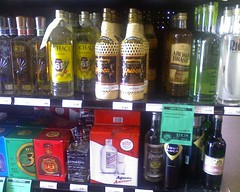
Today we are going to review two different kinds of Cachaca. Not only are they from different brands but they are different styles. One being gold, or ouro in Portuguese, which is usually aged. The other is Silver or Prata, usually, but not always, un-aged. Both are industrial brands. Gold Cachaca is more for sipping and silver is usually used in caipirinhas and Batidas.
We'll start with the Prata: Cachaca 61 is produced by Missiato in São Paulo, Brazil. Cachaca 61 should not be confused with Cachaca 51. Both are named after the year of the brands origin. 61 is 40% abv.
It is crystal clear, absolutely no color. This one has a sweet but strong smell of alcohol, grapes and figs and bit dusty. Its initial taste is slightly lost by the "heat" of the alcohol, powdered sugar followed by pepper.
Score: 79
Now let's move on to the Ypioca Ouro (ee-pee-oka) is produced by the Ypioca group in Ceará, Brazil. According to the label Ypioca ouro has been aged for two years. Ypioca is 39% abv.
Pale, faded gold. In the aroma the alcohol is not as overpowering as the 61. Sweet grape aroma, banana and rosted nuts, praliné. Soft, gentle, caramel, praliné, fruits with a hint of pepper lingering on the tongue.
Score: 89
Now I truly understand why ouro is mainly for sipping and prata for mixing. Although I have tried both sipping the prata and mixing the ouro, the prata is a bit too rough and hot to be sipped where as the ouro is understated when mixed into a caipirinha.
Either way if you are a fan of Rhum Agricole, Daiquiris, Mojitos etc... you should give Cachaca a try by sipping an ouro or with some prata in a caipirinha or batida.
Last time we left off we had spoken about Cachaca. The most famous cocktail which utilizes Cachaça and happens to be the national cocktail of Brazil is the "Caipirinha". This cocktail is a good gateway drink to experience Cachaça, which may be hard to find, but, if you can get your hands on some Cachaca all you need is sugar, a lime, some ice, a low-ball glass & a muddler.
There are tons of recipes out there in regard to the proportions so I would like to share two which I have tried and enjoyed.
The first is from a book my wife got me as a birthday present, it is called "Classic Cocktails" by Salvatore Calabrese ("The Maestro"), who claims to be "one of the worlds leading bartenders".
Salvatore Calabrese's Caipirinha:
50 ml Cachaça
1 small fresh lime
1 1/2 spoons of powdered sugar (I used granulated)
Carefully wash the lime and remove the tips from the top and bottom, to remove some of the pith. Cut the lime in to wedges (going from top to bottom). Place the lime wedges and sugar in a low ball cup and muddle the lime so the juice comes out and mixes with the sugar until it is dissolved. Add the Cachaca and Ice (I like to crush my ice cubes) and stir. Place a straw in it and your ready to go.
Same as above but stir after adding the Cachaca and stir again after adding the ice.
Additionally, according to Hess: "if Cachaca is unavailable in your are you can substitute it with a good white rum". I dunno about this, with out Cachaca its not really a Caipirinha, more like a Daiquiri. Maybe if you use a rhum agricole like we spoke about in last post it would be some what closer. Still... Rum and Cachaca are different, the later is aguardente, not rum.
After discovering this cocktail courtesy of my wife it has really grown on me. Recently my wife went out with my sister and ordered a Caipirinha. Either the bartender botched it or had some other recipe that was the the equivalent of Winston Churchill's "dry Martini", where he waved a bottle of vermouth over the glass of gin, just substitute the gin with Cachaca.
I really recommend the Caipirinha to anyone who wants to experiment with Cachaca or who are fans of Mojitos, Daiquiries and rum to give this one a try.
Hi folks! We are back and gonna be better than evah!
Between papers for college and university plus work it has been very hard to post. Now things are getting back to normal at KYSU so we hope all you loyal fans (if there are any ;) will continue to follow us here
We have not touched on the subject of cocktails for a while on this blog. The last one I reviewed was "The Corpse Reviver". Since I have been away I have been trying some different cocktails which I hope to add soon.
Most recently I fell back in love with the "Caipirinha" after finding Limes in the neighborhood grocery store. Unfortunately by me Limes and good Cachaça are hard to come by. About two years ago I picked up a bottle of Cachaça 61 and tried making a Caipirinha with lemons... just plain wrong. Occasionally I would have some Cachaça & Coke, but as far as sipping goes 61 is an industrial Cachaca and just doesn't cut it. Although it does make a decent Caipirinha.
Some background on Cachaça for those who are not familiar
Cachaça is the Brazilian equivalent of a rhum agricole. Both of which are made out of fermented sugar cane juice as opposed to molasses, such as rums like Bacardi and Captain Morgan are made.
On a brief side note, recently I had an encounter with rhum agricole thanks to my father and enjoyed it thoroughly. I tasted La Favorite blanc, which is bottled at 50% abv, good for mixing and vieux (aged rhum) 40% abv , and good for sipping. rhum agricole is usually, but not always, made in the French West Indies with La Favorite being made in Martinique.
But back to our issue at hand...Cachaca... Also known as "aguardente de cana" or fire water is produced primarily in Brazil. According to USA TODAY "396 million gallons are consumed in Brazil annually". There are two types of Cachaca: artisanal and industrial as well as Silver (Prata) and Gold (Ouro) the difference has to do with the barrels and aging. Some of the well known industrial brands include: Ypioca (which we plan to review in the near future), Pitu, Cachaca 61 and the famous Cachaca 51 that most are familiar with due to their large market share. These industrial Cachacas are generally more for mixing in Caipirinhas and Batidas and less for sipping, although I have heard that Ypioca Ouro is sip-able. There are many artisanal/premium brands like Leblon, Cuca Fresca, etc... but the ones I'd really like to taste are the home made specialties.
My friend, Marcio from Rio de Janeiro, wants to invite me to try some hand made Cachaca he brought back from a four day trip out to the sticks in the country side of Brazil where the Cachaca is supposedly the best. He's really my kinda guy, I mean four days for some killer Cachaca... Awesome!